W Social
How W Social Verifies Every User Is Human, Without Saving Their Data
ABOUT THE COMPANY
W Social is a privately held Swedish technology company building a social media platform for conversations between real people, with a pan-European and international market focus. Its public beta opened on 17 June 2026, with access expanding in phases as the platform scales.
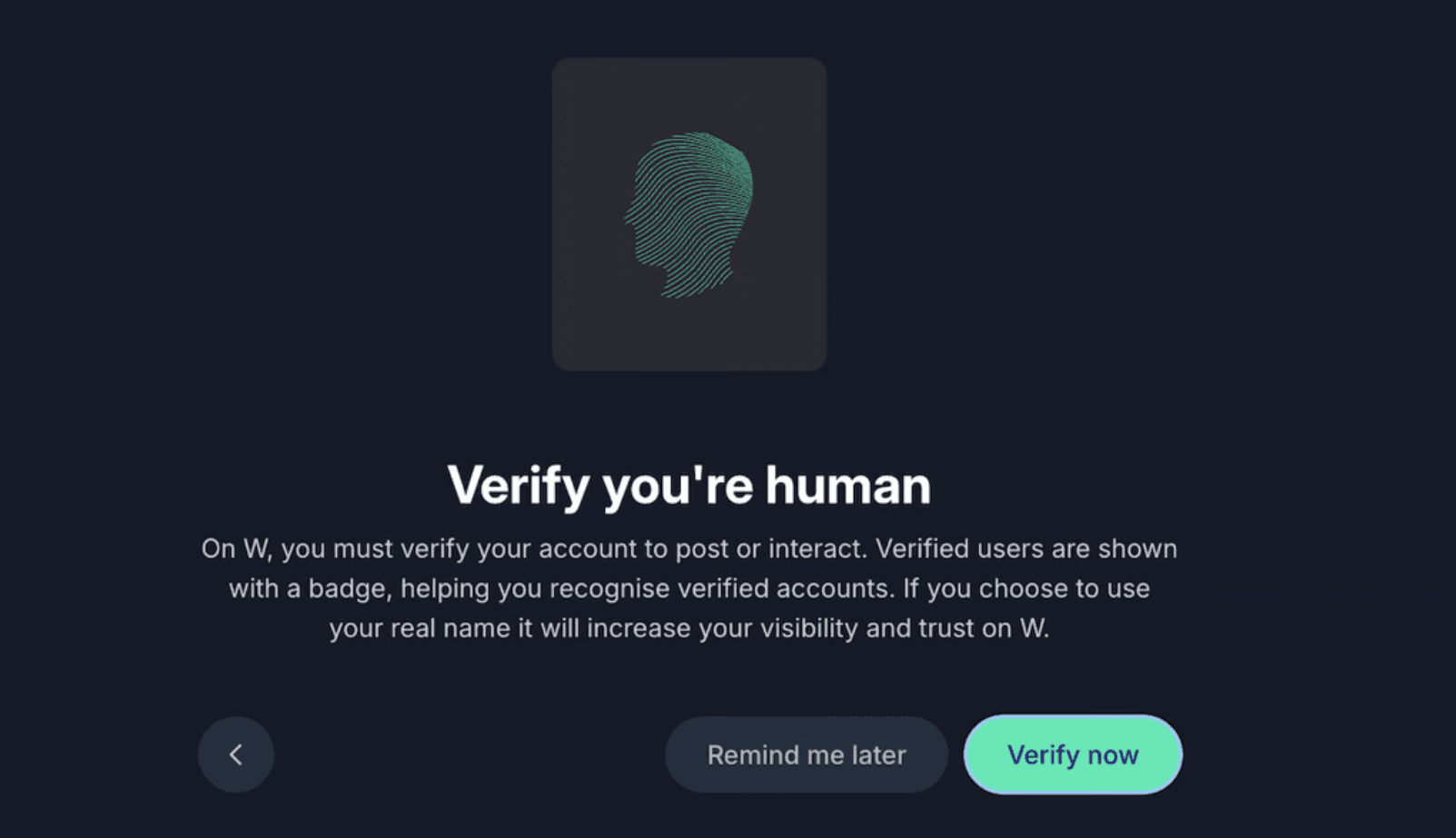
The platform is built around three commitments: verified-human participation, privacy by design, and freedom of expression, all operating under European data governance. Anyone can browse public content on W Social without verifying anything. Posting, commenting, messaging or interacting with other users requires a verified identity first.
W Social also runs on the open AT Protocol, a standard that lets content and social connections move across other compatible applications instead of staying locked inside one company's platform. For a social network trying to earn trust rather than lock people in, that interoperability is as much a part of the pitch as the verification itself.
THE CHALLENGE
Open social platforms share a familiar failure mode: fake accounts, bots and coordinated manipulation crowd out genuine conversation, and there's no reliable way to tell a real person from a script. The standard fix is identity verification, but it usually just relocates the problem. Verifying who someone is typically means the platform itself ends up holding a copy of that person's passport and biometric data, indefinitely: exactly the kind of centralized data store a privacy-conscious user should be wary of.
W Social needed to confirm that every participating account belongs to a real, unique human, without turning itself into a company that stockpiles identity documents. It also wanted that verification layer to run on European infrastructure, under European law, and on an open protocol rather than a closed system it alone controlled.
THE SOLUTION
Neuro built the identity layer as W Identity, an application kept separate from the social platform itself. That separation matters: it means verification can happen without giving W Social unrestricted access to anyone's underlying identity documents.
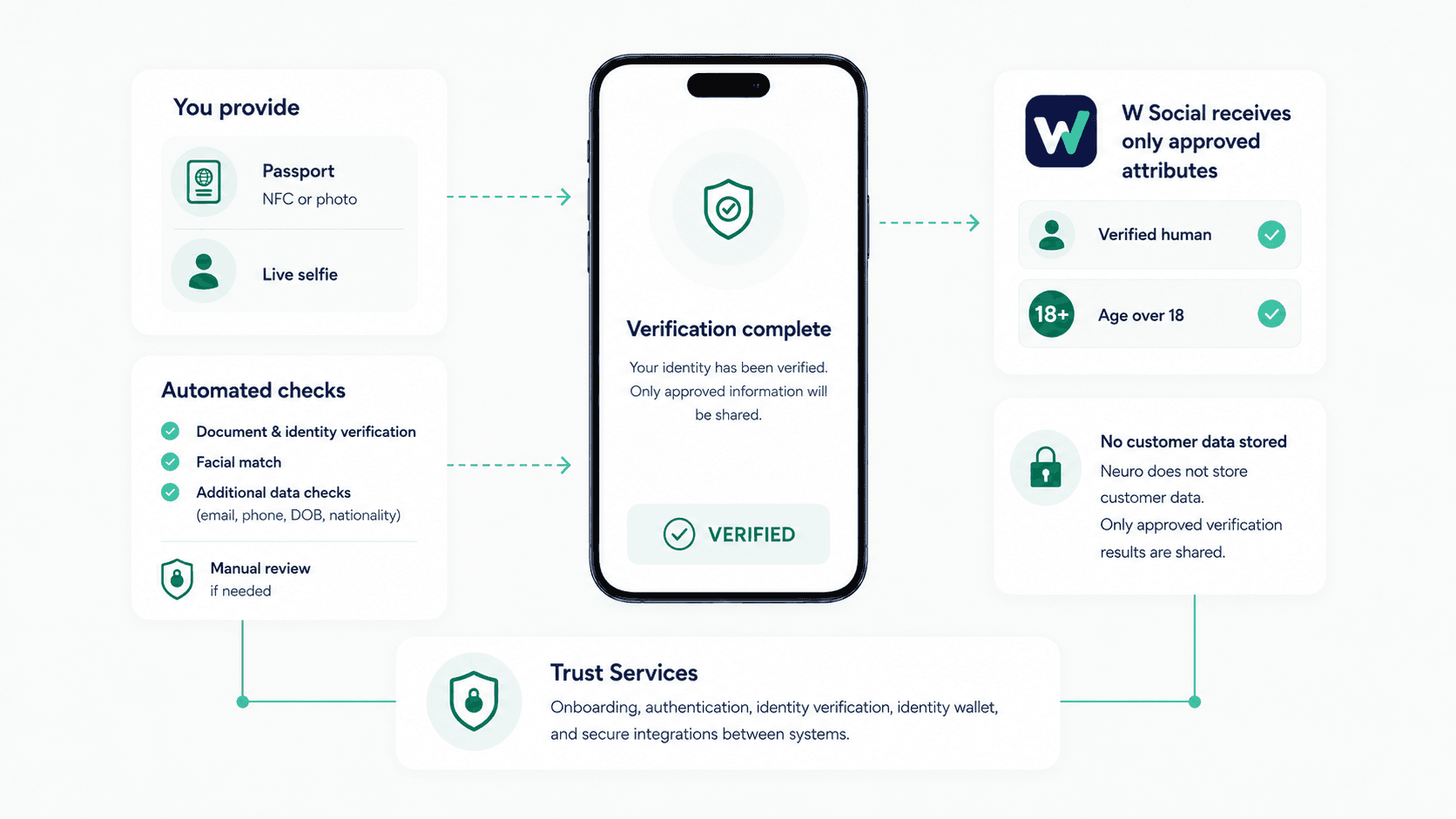
Verification runs through a passport, either photographed directly or read via its NFC (Near Field Communication) chip, matched against a live selfie. Depending on the case, an email address, phone number, date of birth or nationality can also be part of the check. Automated document, identity and facial-matching checks handle the standard flow, running on neuron server infrastructure that Trust Anchor Group maintains. When an automated check can't be completed, an authorised manual review takes over instead of simply rejecting the user.
Once someone is verified, W Identity doesn't hand their full file over to W Social. It confirms only the specific attributes the connected application actually needs: whether an account belongs to a verified human, say, or whether a user meets a given age requirement, and only the attributes that user has approved for sharing. Everything else stays with the user, held in the W Identity application on their own device, under their control.
This layer draws on Neuro Access for the onboarding, authentication and identity-wallet capabilities users interact with directly, and Neuro Identity for the cryptographically protected verification and selective disclosure running underneath it. Neuron infrastructure carries the verification requests and integrations connecting W Identity, W Social and the checks in between.
THE RESULT
Every account able to post, comment, message or otherwise interact on W Social belongs to a real, unique person. That's a materially stronger starting point against bots, fake accounts and coordinated manipulation than a platform that verifies nothing, and a materially more private one than a platform that verifies everything and keeps it all.
Users aren't required to reveal their real name publicly. Someone can interact under a chosen name while still being a verified, accountable human being underneath, which matters for anyone with a genuine reason not to be publicly identifiable. The sensitive part of the process doesn't linger either: for successful automated checks, temporary verification information is deleted within one minute, according to W Identity's privacy notice. Cases that require manual review may be retained for up to fourteen days.
The identity infrastructure was in place for W Social's public beta and is built to support the platform's phased rollout as it grows.
It's also a preview of a broader pattern. As more of everyday life moves onto digital platforms, the ones that earn lasting trust will be the ones that can prove a user is real without becoming another company sitting on that user's most sensitive documents. That's the layer Neuro builds.
If you're building a platform that needs to know its users are real, without becoming a company that stores their passports to do it, talk to Neuro about integrating trusted digital identity into your platform.